

Sound familiar? You’re not weak. You’re not lazy. You’re just human and your phone was specifically designed to keep you exactly where you are.
In this article, we’ll explain why doomscrolling happens on a neurological level, why willpower alone is never going to fix it, and what actually works — including some surprisingly simple swaps.
What Is Doomscrolling, Exactly?
Doomscrolling (also written as doom scrolling) is the habit of compulsively consuming negative, distressing, or simply numbing content online — even when it makes you feel worse.
It doesn’t have to be breaking news or disaster coverage. For many people, it’s just the endless loop of reels, hot takes, and outrage content that social media algorithms are very good at serving.
And it’s clearly on people’s minds. Oxford University Press named “brain rot” — defined as the deterioration of a person’s mental state from overconsumption of trivial online content — as its Word of the Year for 2024, after the term saw a 230% spike in usage in a single year. It’s a somewhat cheeky word, but it points to something real: collectively, we’re becoming more aware that what we scroll through is shaping how we think and feel.
Why Do We Doomscroll? The Science Behind the Habit
The negativity bias. Your brain is wired to pay more attention to threats than to neutral or positive information. This was a survival mechanism for our ancestors — noticing danger quickly kept them alive. Today, the same system makes you stop scrolling the moment you see something alarming, upsetting, or controversial. Social media algorithms know this and exploit it deliberately. A 2024 Stanford study published in PLoS ONE found that it’s typically negative, high-arousal content that gets the most traffic online — and that this content tends to come from the most biased sources on both the left and the right. The researchers described this as a form of “affective pollution.” Harvard Business School research analyzing over 140,000 tweets confirmed the same pattern: negative content engages more users, and news organizations have learned to lean into that.
The dopamine loop. Every new post, every swipe, every notification is a small, unpredictable reward. Psychologists call this a “variable reward schedule” — the same mechanism that makes slot machines so addictive, first identified by B.F. Skinner in his behavioral research. Research published in PMC confirms that likes, notifications, and messages arriving unpredictably create the most powerful reinforcement pattern, making people habitually check social media in anticipation of social feedback. Neuroimaging studies show that social media interaction can significantly activate the striatum — the core brain region of the dopamine system. You don’t know what the next scroll will bring, and that unpredictability keeps you hooked.

The illusion of control. When the world feels chaotic — during a conflict, an economic crisis, or just a rough week personally — checking the news gives us the feeling that we’re staying on top of things. We scroll to feel informed and in control. The irony is that it usually makes us feel more anxious, not less.
Boredom and emotional avoidance. Sometimes we doomscroll simply because we’re tired, understimulated, or trying to avoid thinking about something. The phone is always there, always easy, always offering a distraction. For people with ADHD in particular, the constant novelty of a social feed provides the stimulation the brain is craving — even if it comes at a cost.
Can You Actually Stop Doomscrolling?
How to Stop Doomscrolling: Strategies That Actually Work
Identify Your Trigger, Then Address It Directly
Make Your Phone Less of a Trap
Find Things to Do Instead of Doomscrolling
Micro-learning. This one is worth explaining properly, because it works on exactly the same neurological mechanism as scrolling — just in a direction that actually benefits you. Every time you learn something new and interesting, your brain gets a small dopamine reward. The curiosity is satisfied. The “huh, interesting” feeling fires.
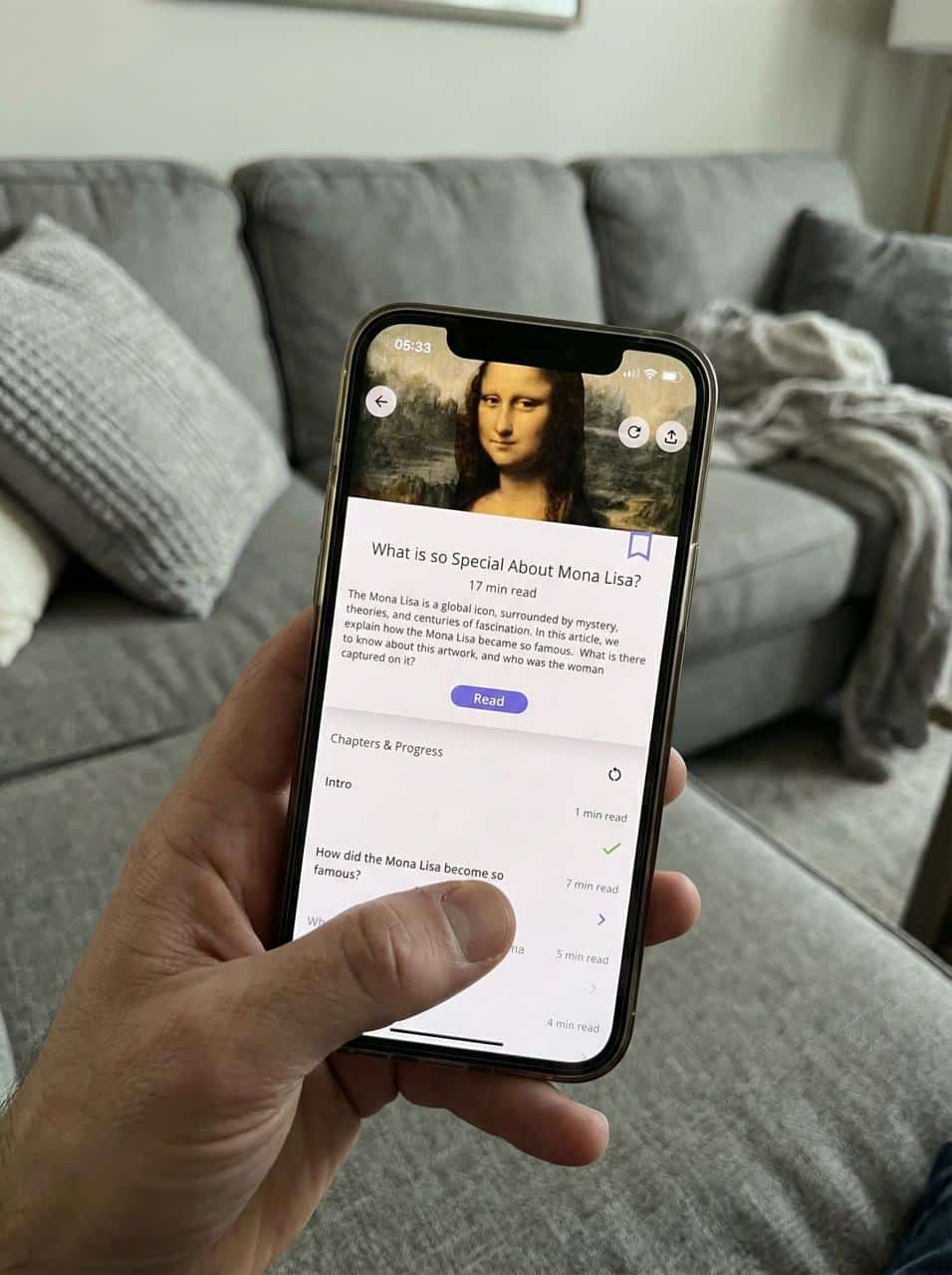
Apps like Nerdish are built exactly for this: short, genuinely interesting reads on science, history, psychology, design — topics that give you the same hit as a good social media post, without the anxiety spiral. A 10-minute article on why the Mona Lisa became famous, or how the first maps were made, or what your dreams actually mean — it hits differently than ten minutes of doomscrolling. You put the phone down feeling curious and a little smarter, rather than drained and vaguely guilty.
And there’s a social bonus too: the interesting things you learn become things worth talking about, which is a lot more satisfying than sharing another outrage post.
Stop doomscrolling. Start actually learning something.
10 minutes on Nerdish > 40 minutes on Instagram. Your brain will agree.


★ 4.8 · Loved by 100,000+ curious minds · Free to Download
Hundreds of topics across science, history, psychology, and art. Each takes 10–15 minutes. Each actually teaches you something.
Curated, positive accounts. You don’t have to leave social media — you can reshape what it shows you. Actively follow accounts that teach you something, inspire you, or simply make you smile: science illustrators, historians, nature photographers, language teachers, craftspeople. And go ahead and mute whoever you need to mute. Your yoga classmate, the school parent whose content always makes you feel vaguely inadequate, the distant acquaintance who posts nothing but grievances — muting someone doesn’t mean you dislike them. It just means you’re choosing what goes into your head. Unfollow or mute freely. Slowly, your algorithm becomes a different place.
Puzzle and game apps. Sudoku, NYT Games, Wordle, crosswords. These meet the stimulation need without the negativity. Many users in r/productivity and r/ADHD specifically recommend this swap — it’s something to do with your hands and brain that has a satisfying endpoint, unlike the infinite scroll.
Intentional content instead of passive feeds. The key difference is choosing rather than receiving. Instead of opening a feed and seeing what the algorithm decided you should look at today, you pick: a saved article you’ve been meaning to read, a documentary you actually want to watch, a podcast episode on a topic you’re curious about. It’s still screen time — just directed screen time, where you’re in charge.
Create "Scroll-Free Zones"
Pick just one zone to protect first. Many people find the first 30 minutes after waking up the most impactful: no phone until you’ve had coffee, moved a little, or had a real conversation. It changes the entire tone of the day.
Schedule Your Scrolling (Seriously)
This sounds counterintuitive, but it works. Instead of trying not to scroll and failing, give yourself an actual scroll window: 20 minutes after lunch, 15 minutes in the evening. Outside that window, the apps are closed.
When scrolling is scheduled and finite, it feels like a choice rather than a compulsion. And that shift — from “I can’t stop” to “I chose this” — is more powerful than it sounds.
Accounts Worth Following Instead of Doomscrolling
If you’re going to be on social media anyway, here are the kinds of accounts genuinely worth your time:
- Science communicators who explain complex topics in a sentence or two
- Historians and archaeologists who share weird facts from the past
- Language and etymology accounts that make you think differently about words you use every day
- Mental health educators who explain psychology in plain, non-preachy language
- Nature and space photographers — the visual equivalent of a deep breath
- Craft creators — people who draw, crochet, grow plants, build things with their hands. Watching someone make something has a quietly calming effect that doom content never does.
A Quick Note on Willpower
You’re not trying to become a different person. You’re just slightly rearranging the furniture.
TL;DR: How to Stop Doomscrolling
- Doomscrolling is driven by negativity bias, dopamine loops, and the need for stimulation or control — not weakness
- Quitting cold turkey rarely works. Mindful, intentional scrolling is a more realistic goal
- Identify your personal trigger (anxiety, boredom, avoidance) and address it directly
- Add small friction to make reflexive scrolling harder
- Replace the scroll with something that meets the same need: micro-learning apps like Nerdish, puzzle games, curated positive accounts
- Protect a few scroll-free moments in your day, especially mornings and bedtime
- Schedule scrolling time rather than fighting the urge constantly
The goal isn’t a phone-free life. It’s a life where you’re the one deciding what goes into your head.