
General knowledge: why do we need that?
More and more people are concerned about general knowledge improvement nowadays. Why? Many reasons:
- Everyday skills like problem-solving, communication, and critical thinking all require a solid knowledge base
- From a social point of view, we’re often judged by how much we know — it’s hard to make a good impression without it
- General knowledge boosts confidence and helps you express clearer, more interesting opinions
- It pays dividends in your career, relationships, and personal development
General knowledge is the foundation on which you build everything else.
Improving general knowledge will pay dividends in all areas of your life. Beyond the obvious benefits of being well-informed, research shows a direct link between broad knowledge and creativity. As Roger Beaty, psychology professor at Penn State University, puts it: “Memory is what we already know. Creativity involves going beyond what we know — but if we don’t know anything, we can’t create anything new.” The more you know across different fields, the more unexpected connections you can make — and that’s a skill that never goes out of date.
There are plenty of things you might try to gain general knowledge about, and we would like to highlight some of them.
How to improve general knowledge?
Use the Nerdish app to gain knowledge about everything
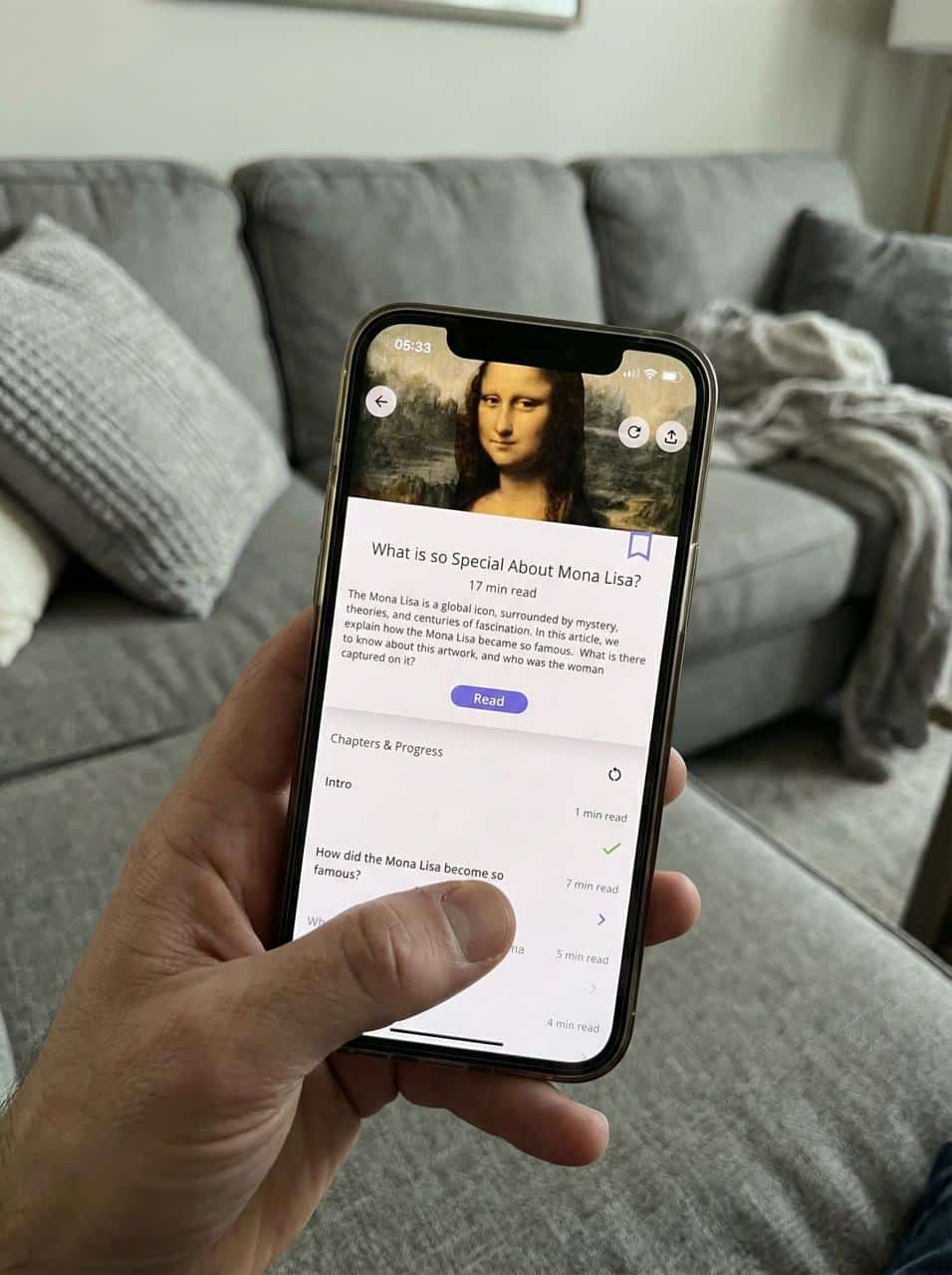
We in Nerdish are all continuous learners and that’s exactly why we built this app. We wanted a place where you can quickly learn about a wide variety of topics, with content based on deep research but easy to read and enjoy. Each article focuses on one topic, cuts away unnecessary detail, and connects ideas so knowledge actually sticks. No courses, no schedules, no pressure — just one interesting topic whenever you have a few minutes.
We also added a reading progress tracker to help you stay consistent and see how far you’ve come. A healthy alternative to social media scrolling — one that actually leaves you knowing something new.
Turn your spare minutes into real knowledge
Because curiosity deserves better than endless scrolling.


★ 4.8 · Loved by 100,000+ curious minds · Free to Download
What else might you do to gain knowledge?
Read
The essential way to learn about anything is by reading quality literature: books, articles, blogs.
Exactly where Nerdish may help you: explore a variety of Nerdish topics across different areas of knowledge.
It’s a scientific fact that 65% of people prefer visual information, so reading is suitable for most of us. Apart from learning new things, it enriches the language by boosting vocabulary and showing word usage. Also, reading activates multiple cognitive functions: attention, concentration, comprehension, and analysis. Simply speaking, reading stimulates our brain activity and makes us smarter on the physical level.
To transform reading into a habit, you should try reading every day and always have some materials on you, whether printed or digital. To choose books to improve general knowledge, you can rely on recommendations from Amazon, the New York Times, etc. These lists can give you ideas of what to read and how to get it. You might even join some book club to keep your pace and socialize with people who have similar interests as you. Check our post How long should I read a day to choose the best reading strategy.
Listen
It is also worth mentioning that we can learn not only from books. We can expand our life frames with versatile sources, like podcasts. They don`t spread only entertaining content, but also educational one. We can get the newest information from experts in different fields: economists, sociologists, art managers, etc., in simple and more personalized language. Plus, podcasts are portable, so you can easily combine listening with waiting-chores-shopping and thus transform a boring routine. iTunes is your number one provider in this case.
We’ve recently introduced the Listening feature in the Nerdish app also. Now, besides reading brief, science-related articles, you can listen to them too. This allows you to broaden your general knowledge while walking, exercising, or doing daily chores—without needing extra time. The aim is to integrate learning seamlessly into your routine, so gaining new knowledge becomes a habitual part of your day instead of something to delay.
Watch
Okay, it`s hard indeed to stop rewatching “Friends” episodes for the hundredth time, but how about mixing it up a little? You can totally learn lying on the sofa and hugging a cat. There are plenty of documentary movies, explanatory videos, professional channels, and TedTalks: a myriad of sources for increasing your knowledge. Learning through watching provides you with visual and auditory information and has a strong emotional impact (through actors’ performances, set decorations, and music), so you are more likely to memorize the presented facts.
Follow the “one thing a day” rule
To gain knowledge about everything, you might implement some basic self-demands that would ensure real progress in a short time. For instance, you can try learning one new thing every day. Either a big and complicated concept or something simple, like “Why Mona Lisa is so popular?”
Even if you don’t have much time, you surely can find spare five minutes for one fact. Just think about it: one month later, you will grasp thirty new things about various issues.
Socialize

You don’t have to bury your nose in books to become more intelligent. Knowledge may come from conversing with others when interacting with their culture, language, life views, etc. Try to participate in conversations with educated and experienced people to gain life-based knowledge. People with different backgrounds and life views give you some wholly new perspectives, enlarge your life frames and push you to think out of the box.
Explain things to others
The second important part of socializing is telling stories and explaining some things to others (only if those others are interested). Your new knowledge can become a fascinated theme for conversation. Numerous studies show that the brain needs to reproduce information to improve memory. In this way, neurological connections are created to ensure that knowledge is safely saved. So, explaining things to others is beneficial not only for your know-it-all reputation but also for boosting your intelligence.
Plan out your general knowledge improvement journey
It may seem like a lot of work, but if you plan first, you will study more constantly, cover different topics evenly and implement learning into your day-to-day life. First of all, you can define areas of general knowledge you should know: geography, history, art, political systems, or herbology: whichever topics you’d like to know, it’s helpful to see them before your eyes. Choose topics you are interested in and start with them. Focus on small sessions covering one subject at a time.
Mix it up
While it`s helpful to concentrate on one topic in one learning session, our brain needs variety. Different subjects help activate other brain parts and change intensity. Even a question we are interested in can become boring if we focus on it exclusively. Mixing up applies not only to subjects but to learning approaches too. For instance, you read about The paleo diet in the morning commute, then have small chitchat with your coworker about a new art exhibition, then you listen to a podcast about new technology on your way home. You will cover three different topics with three various sources. Your brain is going to love this.
Learn regularly
To feel real progress, remember to study regularly. The rule applies that learning less every day is better than suffering for 8 hours once a month. Again, one thing a day rule is your lifesaver. Learning is one of the best instruments to fill ‘dead’ time and have this feeling of achievement before you go to bed. Suppose you need motivation not to give up. In that case, you can set a goal∶ to pass a general knowledge test with 90% accuracy, memorize all world`s capitals, understand the meaning of all famous Greek metaphors, etc. These goals will work as inner fuel and won`t let you give up in the middle.
Another motivation tip is to ask friends or family members to assist you or join you in your pursuit of knowledge. You can listen to the same podcasts, read the same books or watch videos together and discuss them afterward. In this way, you might become even closer and have one more experience to share.
Join thousands of Nerdish users worldwide
Try Nerdish free for 7 days and see if learning feels different this time